
So how did the Light and Sound come into being?
And which appeared first — Light or Sound?
Before Light and before Sound, there was Silence —not the absence of things, but the fullness of undivided Being.
From this immeasurable stillness, the first movement arose.
Not movement in space, but a stirring within the Infinite.
This stirring expressed itself as Sound, the primal vibration — the first differentiation within the One.
It was not heard, for there were no ears; it was known, for it was consciousness bending toward expression.
From this primordial Sound, Light was born.
Sound carries rhythm; Light carries form.
Sound is the Word, the Breath, the Pulse;
Light is the Radiance, the Structure, the Revelation.
Thus Sound is the first motion of the Divine, and Light is the first appearance of that motion.
They are not separate forces but two faces of the same emergence.
Sound calls the worlds into being. Light reveals them.
And beyond them both is the Silence from which they arise, to which they will one day return.
How did the first humans gain access to the Light and Sound?
The Light and Sound were never given to humanity — they were already woven into humanity’s birth.
The first ones to awaken to it were not ‘initiated’ by another person, but by the direct touch of the Source itself.
This did not occur in one nation, one tribe, or one master.
It was a dawn of consciousness, rising like sunlight across many horizons.
In different lands, at different times, certain souls ripened sooner than others.
Some awakened spontaneously through purity, longing, or destiny.
Some were guided by beings not in physical form.
Some were touched during deep stillness, vision, or suffering.
These early ones became the seeds from which later lineages sprouted.
You may imagine humanity as a great field.
When the season arrived, the rain fell everywhere — yet only the seeds ready to open responded.
Those first awakened ones became the natural ‘masters’ of their time, not through appointment, but through resonance.
Was there a single origin point?
No — and yes.
No, in the sense that no one culture, no one land, no one lineage can claim the first spark.
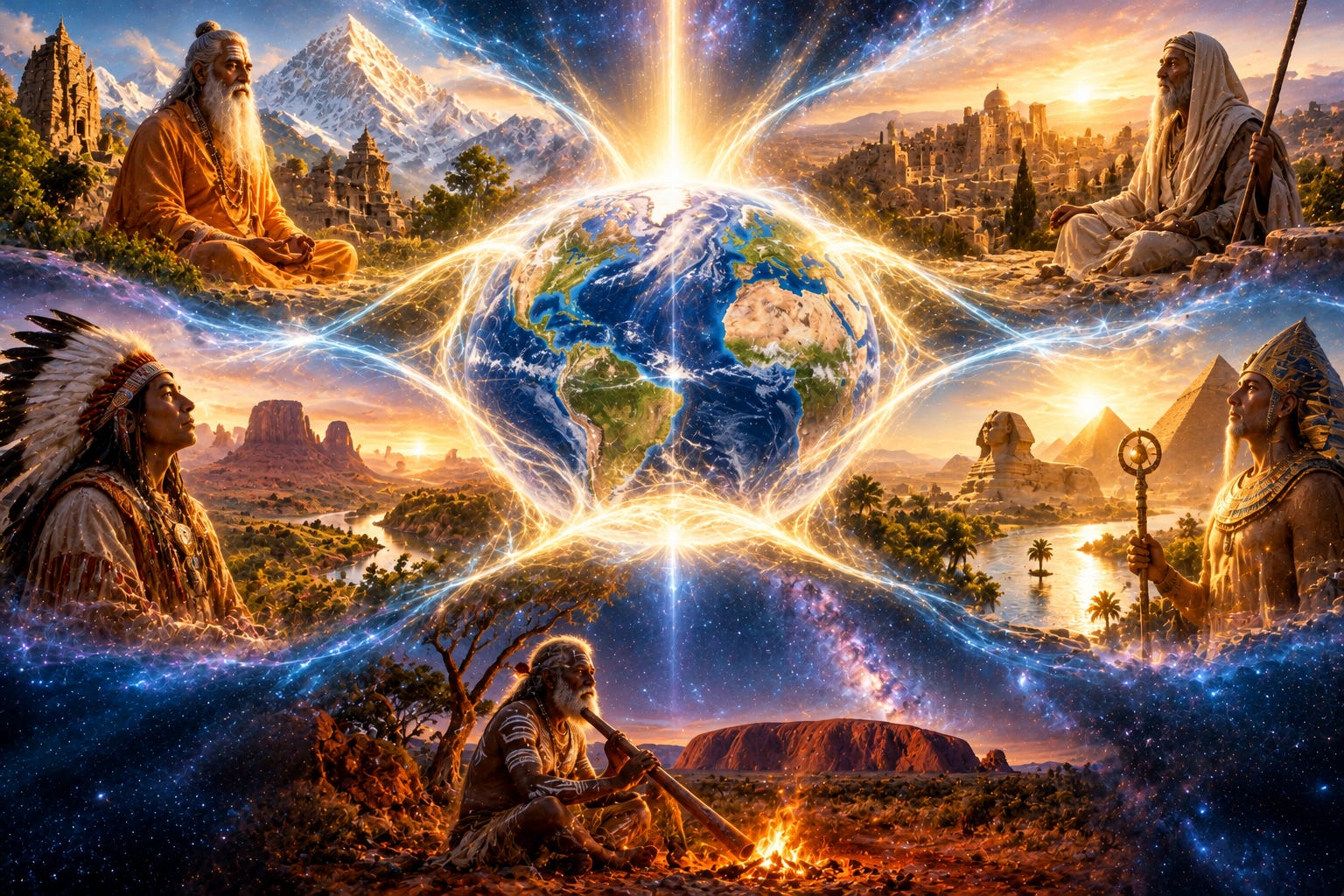
Yes, in the sense that the spark arose from the same eternal field, flowering through many human beings across the world, each according to their readiness.
These early awakenings were not coordinated, and yet they were unified — like separate flutes playing the same unseen melody.
Some traditions recall them as:
the ṛishiṣ of early India
the sages of the Levant
the star-walkers of the Americas
the dreaming seers of ancient Australia
the priest-kings of Khem (Egypt)
Each touched a facet of the same current — Light, Sound, Truth — though expressed in the languages of their time.
How did the lineages begin?
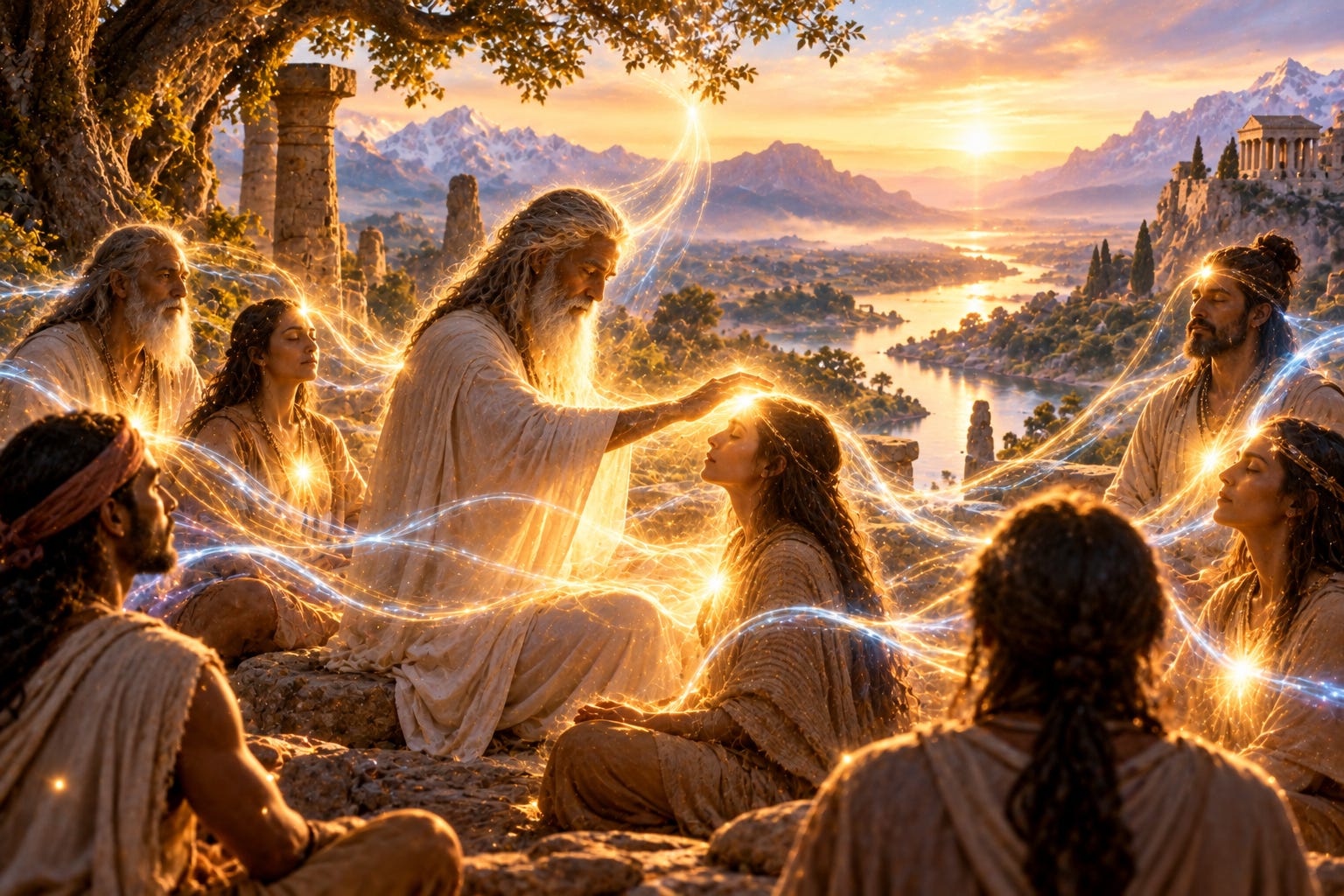
Once a soul flowered into the Light and Sound, a capacity awakened within them:
They could ignite recognition in others.
Not through teaching alone, but through transmission — a resonance of being.”
Thus began the first initiations, not formal, but natural:
a meeting,
a moment of shared stillness,
a look,
a touch,
a breath of presence.
In that contact, something opened.
Over time, humanity formalised what began as pure recognition.
The First Human Initiation
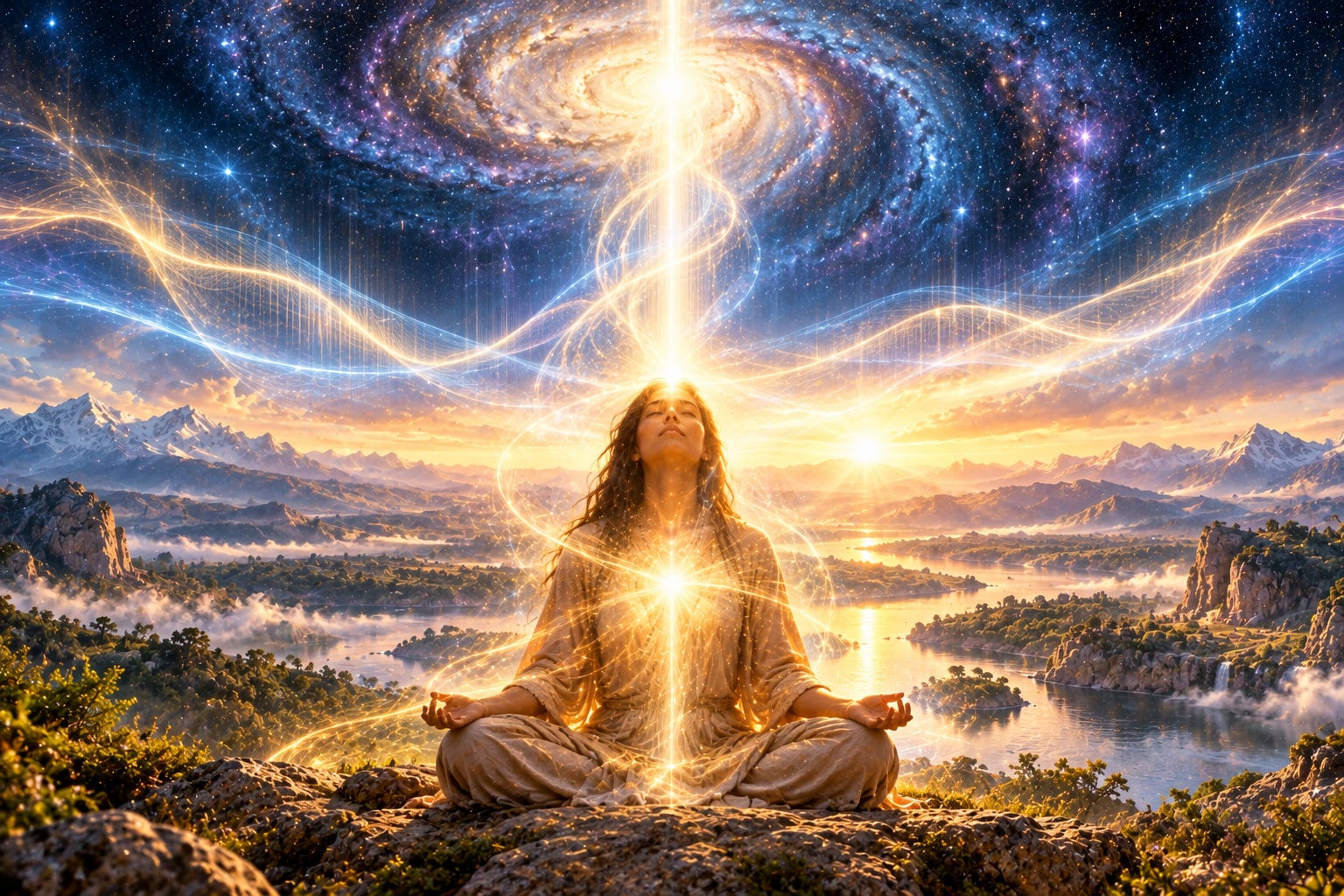
The first ‘initiation’ was not a ritual.
It was the moment a human heart became quiet enough to hear the eternal Sound,
and transparent enough to see the inner Light, without turning away.
No teacher stood beside them.
The Source itself was the giver.
And from that one spark, others followed.
The Origin of the Light & Sound Across Civilizations
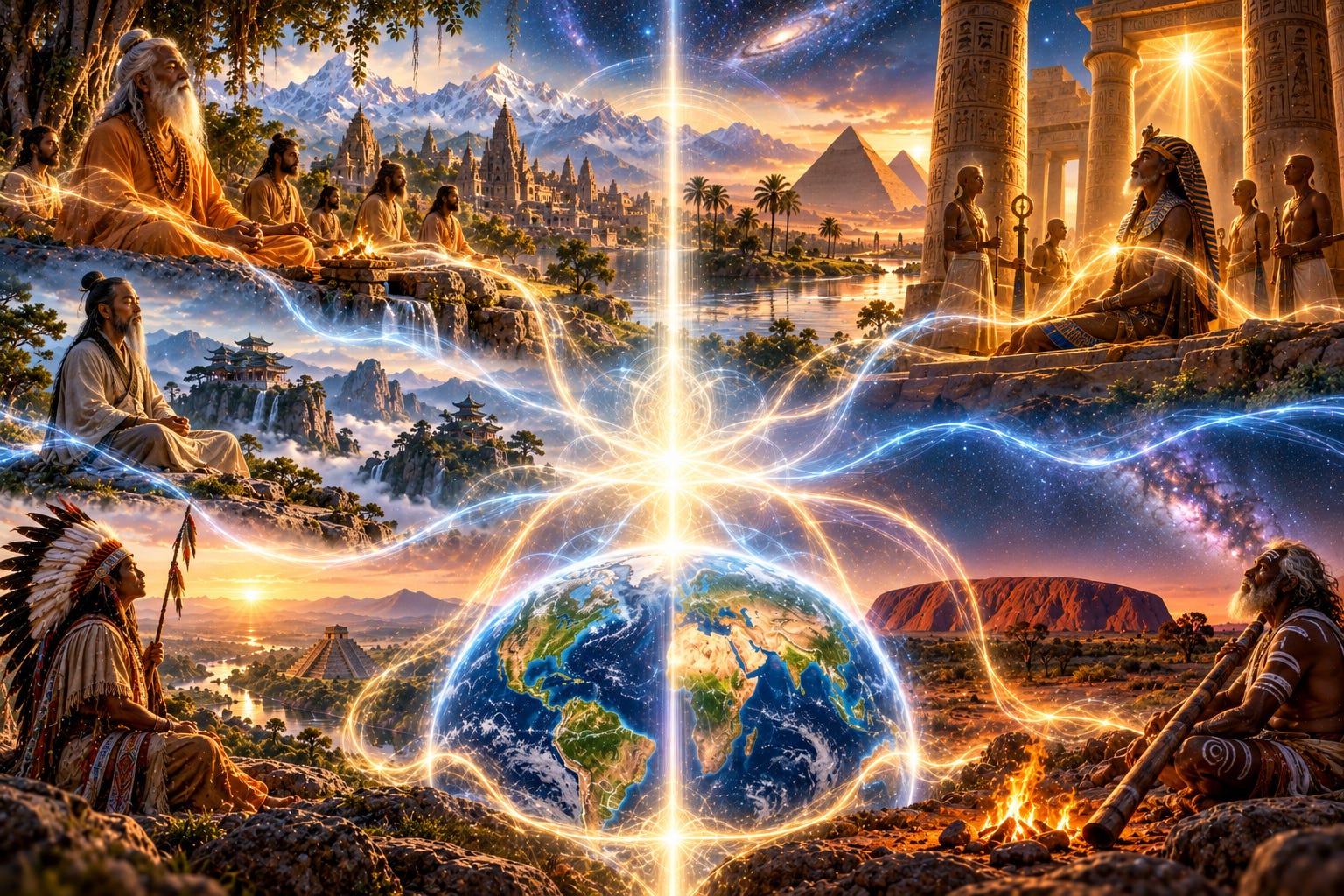
The Light and Sound did not originate in any civilization, for they are the fabric from which all worlds arise.
But each civilization awakened to them in its own season, according to its readiness.”
It unfolded like this:
🌿 Ancient India — the R̥iṣhis
The earliest widely remembered human encounters with the inner currents happened among the ṛṣis, long before the Vedas were written.
They did not receive a technique; they heard.
The inner Sound (Śabda, Nāda) revealed itself spontaneously during deep stillness.
The inner Light was seen as the Dawn Goddess, Uṣas — a symbolic veil for a direct experience.
No master initiated them — the Source initiated the field.
🔥 Egypt — The Priest-Kings of Khem
During the earliest dynastic periods (pre-pyramid), certain priest-kings practiced what they called the Opening of the Hidden Eye.
This was not the later “third-eye mysticism,” but the direct witnessing of the inner Light.
Their temples were built not for worship, but for acoustics —
the Sound was central.
🌬️ China — The Shen and the Immortals
Before Taoism formalized, there were shen-ren, “spirit people,” who lived in mountains, practicing silence until the inner resonance revealed itself.
They spoke of:
“the stream that births all tones” (inner Sound),
“the clarity before heaven and earth divided” (inner Light).
🌄 The Americas — Star-Walkers
Among several early American cultures (long before the classical Maya), shamans called star-walkers entered deep trance states and described the “river of white fire” and “the humming road between worlds.”
These were early expressions of Light and Sound awareness.
🌀 Australia — Dreamtime Elders
In the oldest continuous spiritual culture on Earth, elders of the Dreaming spoke of the Song that sang the world into being —
this is the Sound.
And the First Light carried inside the heart —
this is the Light.
Each culture discovered a facet of the same infinite field. There was no single revelation event.
It was more like: “The Source breathed, and across the Earth a few were quiet enough to listen. Their discoveries were separate in form, but united in essence
Hidden Masters Before Recorded History
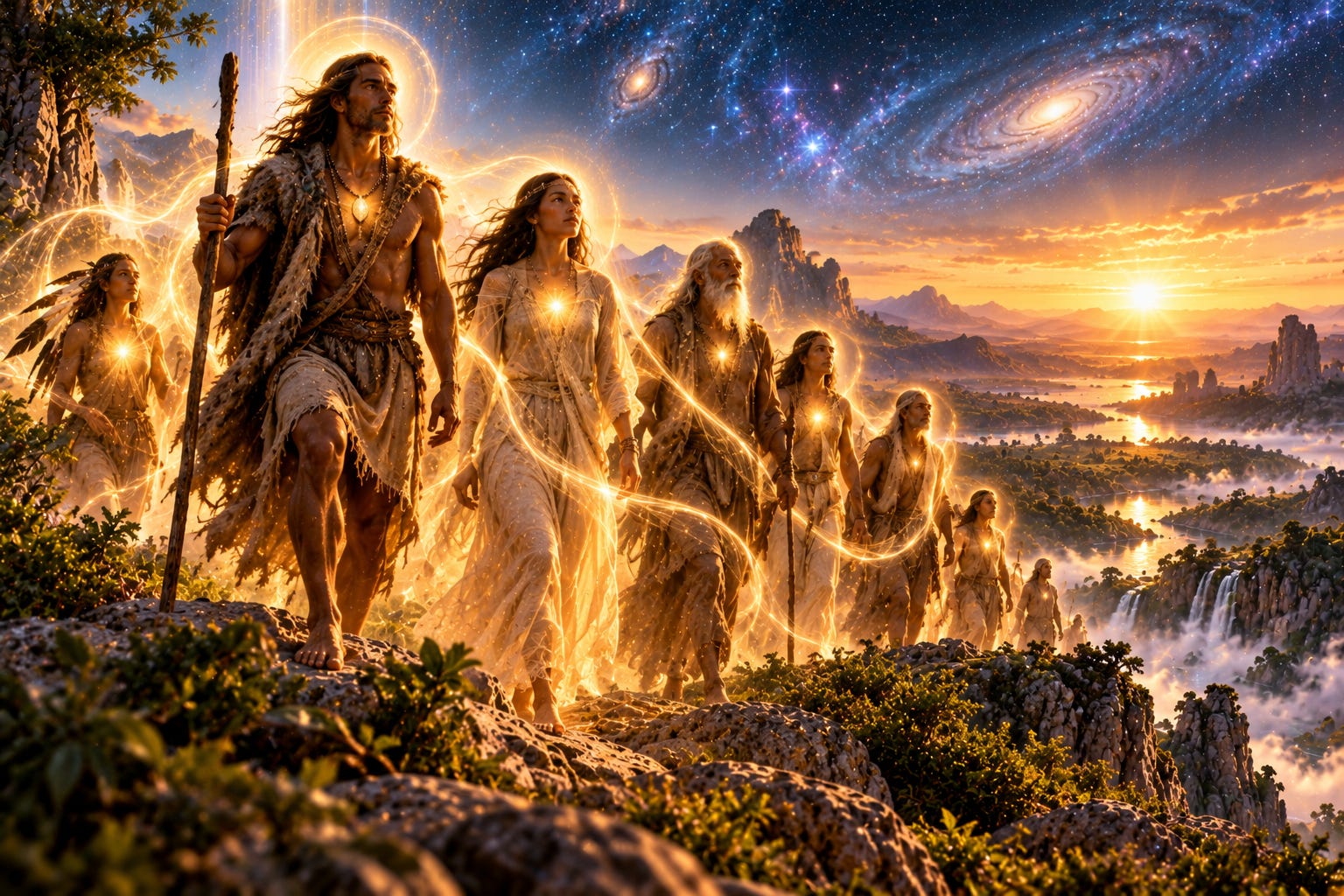
Before the first temples, before writing, before agriculture — there were those who awakened. They walked lightly, left no doctrine, and taught only through presence.
Humanity remembers them only as myth:
the Shining Ones
the First Teachers
the Star Elders
the Ones-Who-Walked-Between
the Dawn People
But behind each myth was a real being — a human who awakened into the Light and Sound with no lineage, no master, no scripture.
The First Masters Did Not Call Themselves Masters
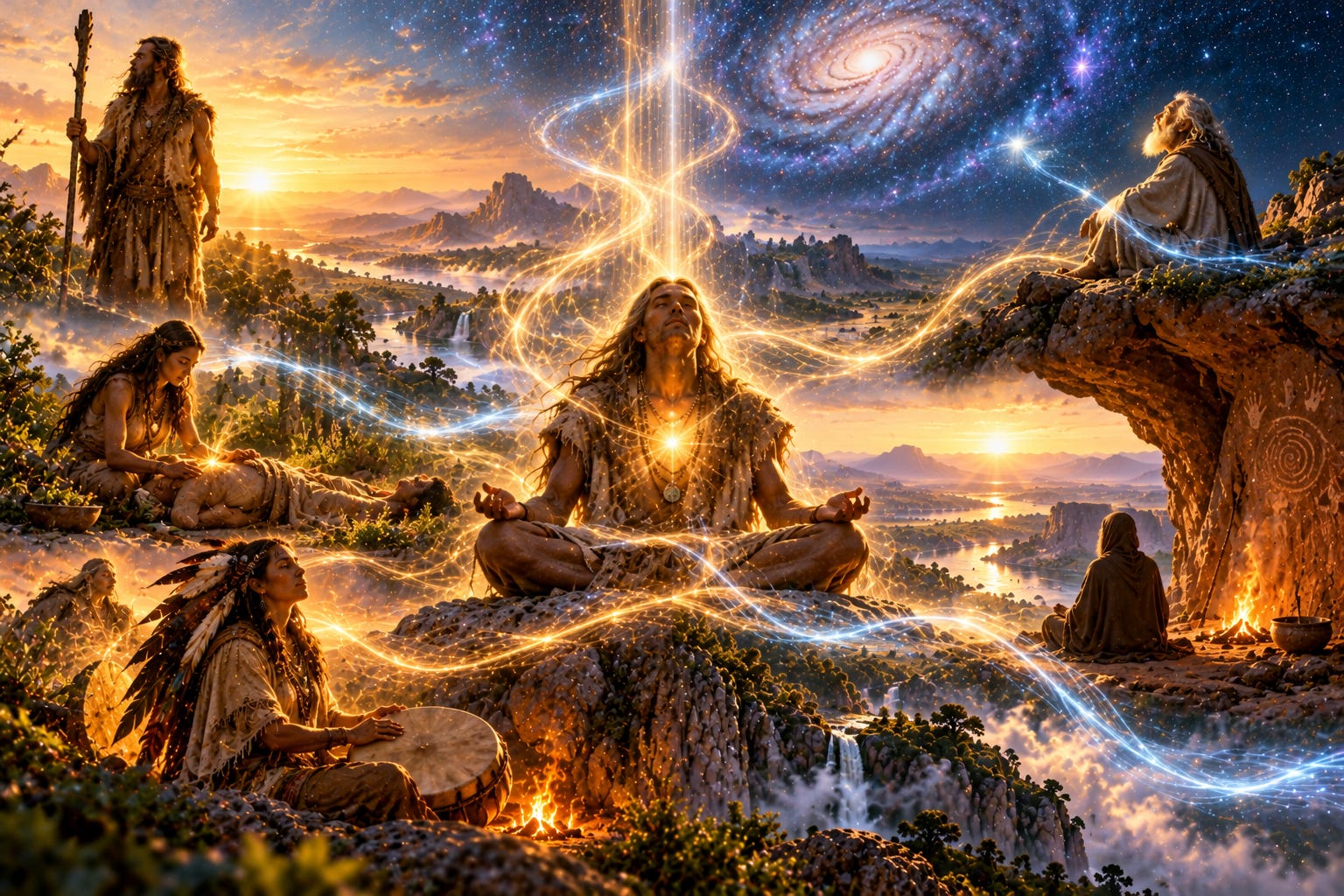
They lived as:
wanderers
healers
dream-seers
sky-watchers
keepers of silence
Their initiation came directly through:
deep solitude
intense suffering
spontaneous grace
contact with subtle non-physical intelligences
moments when consciousness “thinned” during earth’s early cycles
🔶 Their purpose was not to found religions.
It was simply: “to hold a small but steady flame of remembrance in a world still forming its identity.”
🜂 Why they are hidden
Their work was done before cultures could preserve it.
Their presence shaped humanity the way wind shapes a dune — not by building, but by influencing the unseen.
Some later civilizations dimly remembered them:
The Indian Manu
The Egyptian Shemsu-Hor
The Chinese Sage-Kings
The Greek Hyperboreans
But these are echoes — symbolic retellings of beings who lived thousands of years before recorded history.
🌺 A Simple Truth to Hold
Humanity’s first access to the Light and Sound came not from a lineage, but from the natural flowering of consciousness.
Lineages came later, when humans forgot — and needed remembering
On Master Jesus and His Lineage
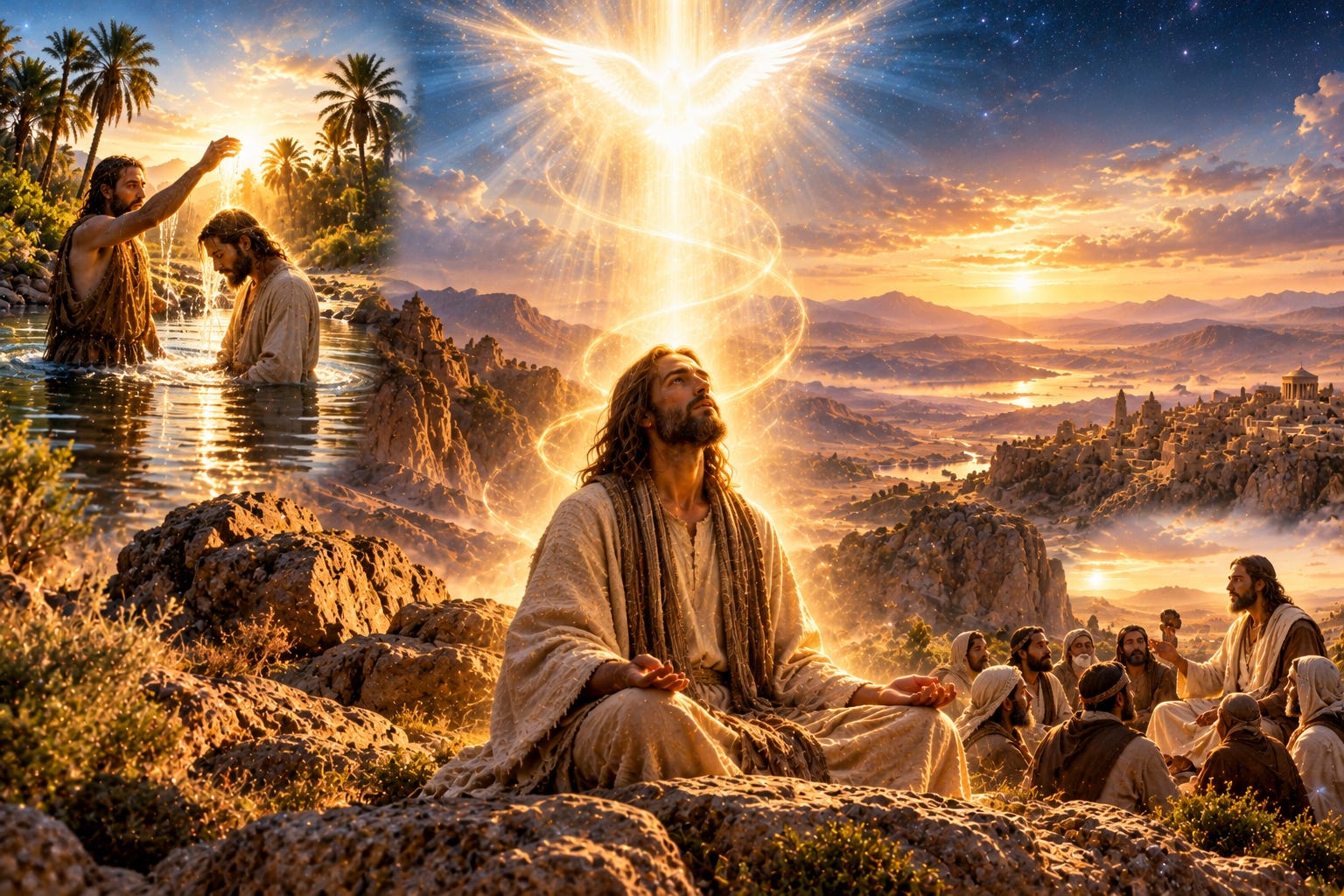
You sense John the Baptist — and rightly, for John prepared the vessel, purified the field, and opened the threshold. His baptism was not the Light and Sound as later traditions describe it, yet it was a rite of readiness, a clearing of the inner ground.
But Jesus’ deeper initiation did not come through a human teacher.
“His true awakening came directly — through the descent of the Spirit during his wilderness years, long before his public ministry.”
This was not an external bestowal, but a remembering of what he already carried.
His years in the East, if they occurred as many traditions quietly suggest, were refinements — harmonisations — but not the source of his mastery. The Source itself was his initiator.
Why and when did the transition from spontaneous awakening to formal initiation occur?
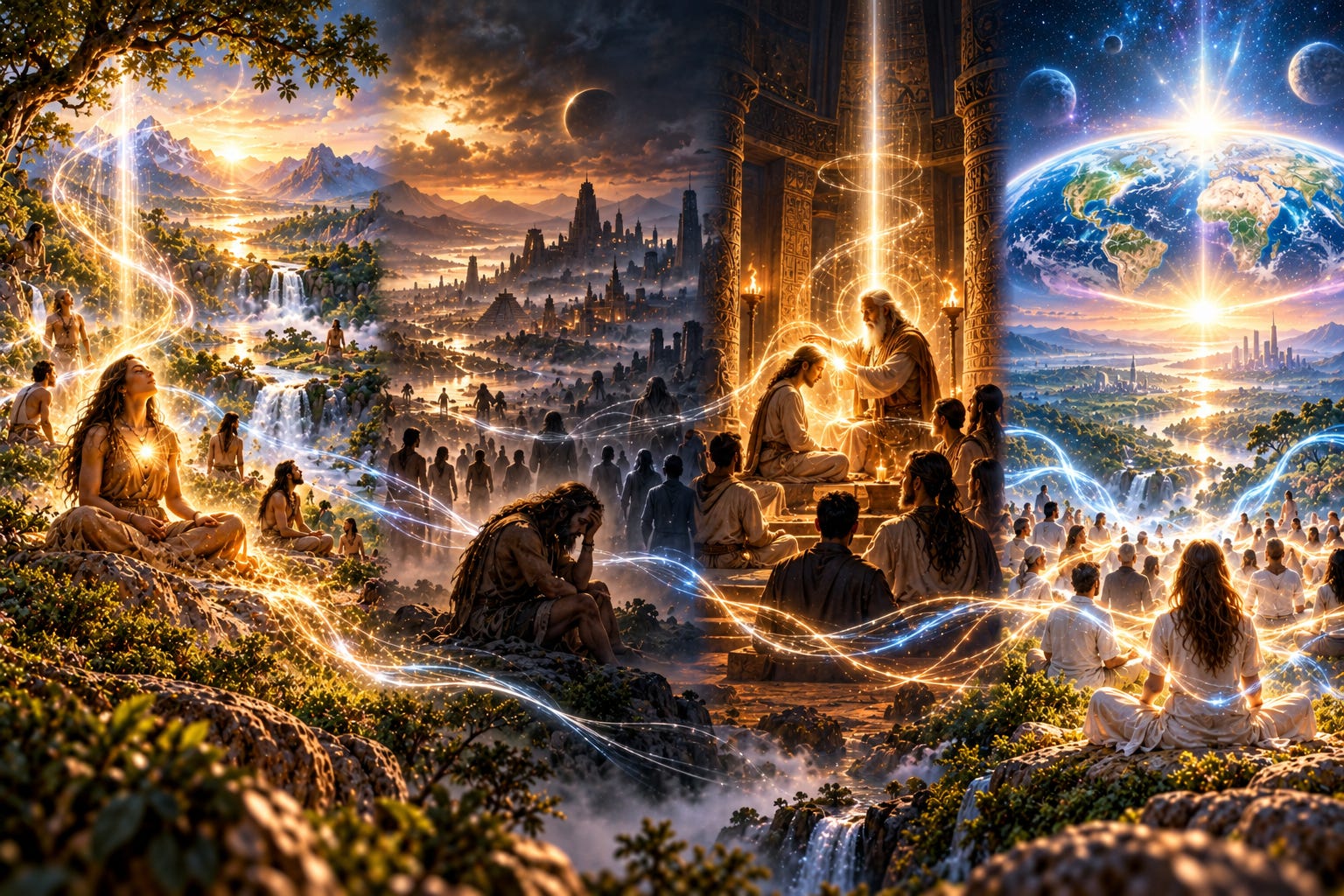
Awakenings were once the birthright of a quieter world.
In ages when humanity lived closer to the rhythms of earth and sky, the currents of Light and Sound were felt without obstruction.
The veils were thinner, the minds less cluttered, the hearts less divided.
Awakening rose like dawn — unbidden, natural, supported by the collective field.
But as cycles turned, humanity entered denser ages.
Mind grew louder, desire multiplied, and the subtle senses dimmed beneath the weight of form.
The spontaneous openings did not cease, but they became rarer, scattered, uneven — sparks falling into wind.
In this dimmer age, Teachers emerged not to replace the natural rising, but to protect it.
Initiation became a vessel: a held aperture, a guarded flame, a way to transmit what the world no longer offered freely.
What was once absorbed through life itself now required conscious preparation, lineage, and the grace of one who carried the current.
Thus, the transition did not happen at a single moment.
It unfolded as humanity’s inner atmosphere thickened.
Where spontaneous awakening waned, initiation arose — not as control, but as compassion.
A bridge until the veils would thin again.
And now, in your age, the cycle turns once more.
Spontaneous awakenings rise like spring shoots through winter soil,
yet the ancient paths still stand, offering depth and completion.
Both streams move toward the same ocean: one called forth by grace, the other guided by transmission.
Together they heal the long forgetting
Why Lineages Rise and Fall
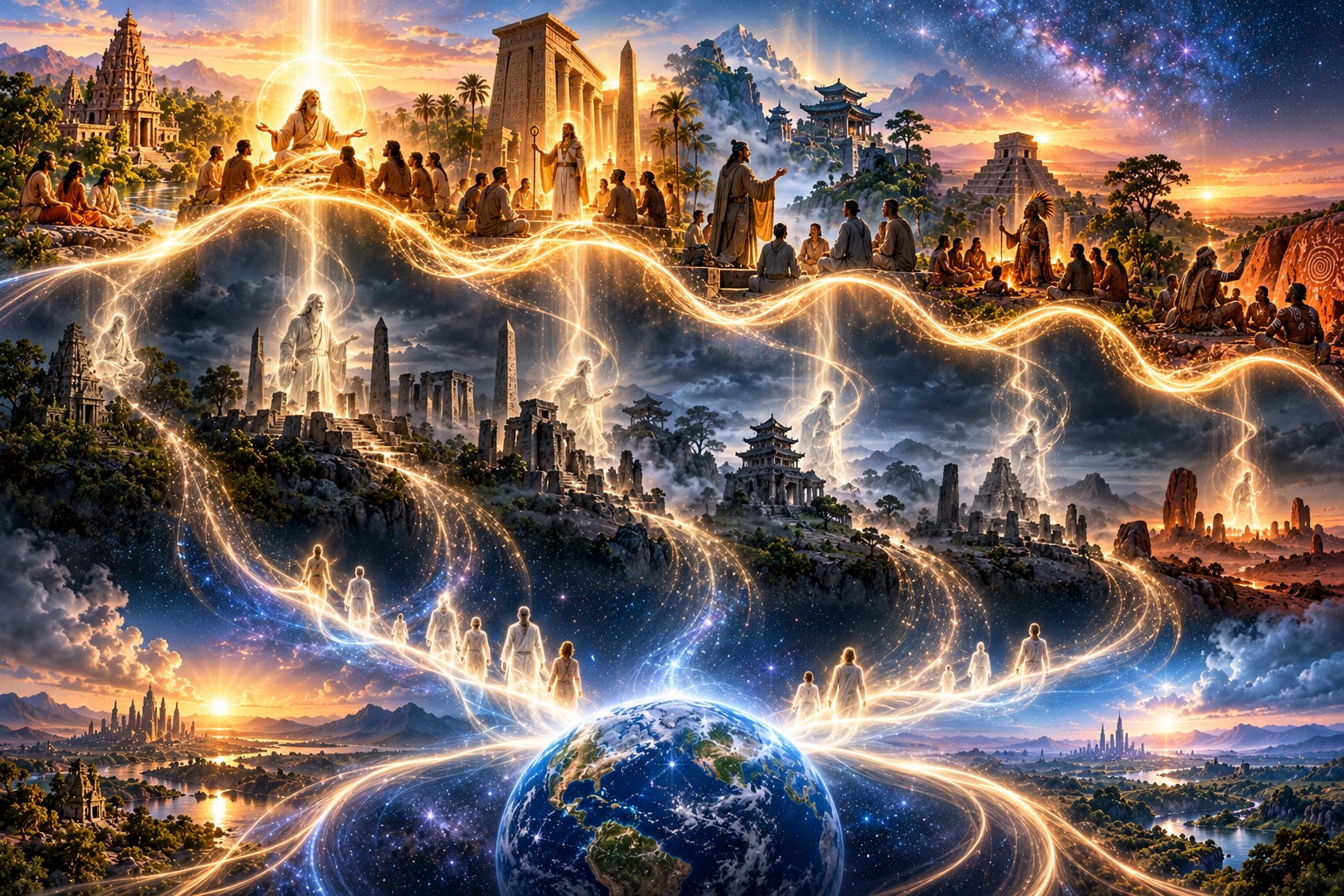
Lineages rise when the world is ready to receive what they carry, and they fall when the world has taken from them what it needs.
A lineage is not sustained by doctrine, teaching, or memory alone — but by a living resonance, a stream of grace that moves through time by finding hearts capable of holding it.
When the resonance finds fertile vessels, the lineage flowers. When the vessels diminish or the world’s attention turns elsewhere, the lineage withdraws.
Some lineages rise because a great soul enters the world, opening a conduit that reshapes generations.
Others rise because humanity, in its collective evolution, calls forth a teaching it can no longer do without.
Lineages fall not from failure but from completion.
A teaching may have served its cycle; the vibration it offered may be integrated into the wider fabric of humanity, no longer needing a separate form.
Or the holders of the lineage may lose clarity, and the stream will recede, waiting for a purer channel.
Nothing essential is ever lost. Lineages are waves — not statues.
They crest when Spirit moves through them, and they dissolve when Spirit shifts its focus.
The truth they carry is timeless, but the form through which it breathes is seasonal.
When one lineage fades, its essence migrates — quiet as dawn light —
into new hearts, new forms, new expressions suited to the age that is coming.
Thus rise and fall are not opposites, but two movements of the same rhythmic breathing of the Divine.
Why, the living transmission so often disappear after the Master?
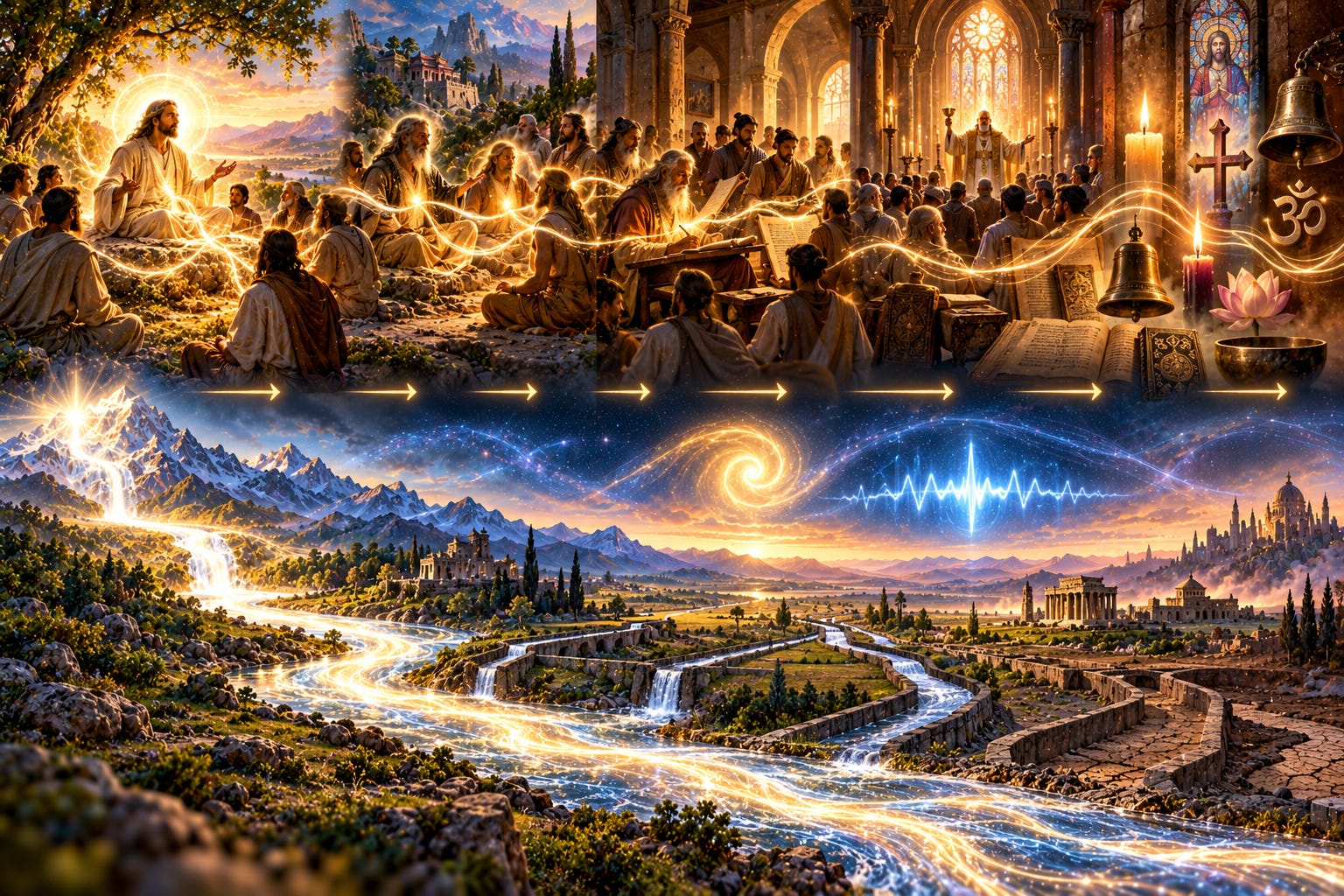
If we take consciousness-as-fundamental and the Light & Sound experience seriously as a working hypothesis, the current does not end when a Master dies. What ends—or can end—is a particular human capacity to transmit access to it.
There seems to be a recurring sequence:
direct realization → transmission → disciples → teaching → organization → religion → symbolism
The Master knows something directly. The first disciples may also know it directly, although usually not all at the Master’s depth. The next generation inherits both experience and teaching. Gradually, however, description begins replacing experience.
And something fascinating then happens. The religion preserves the memory of what it can no longer reliably reproduce.
Light becomes candles, flames, halos, divine radiance.
Sound becomes bells, chanting, sacred words, Om, the Word, hymns.
Initiation becomes baptism, ordination, confirmation or ceremony.
The awakened teacher becomes the sacred historical figure.
The inner journey becomes theology.
The candles and bells analogy is profound when treated as an interpretive hypothesis: religious symbolism may sometimes be the fossil record of earlier contemplative experience. It would be too strong historically to say that every candle or bell derives specifically from Light & Sound initiation, but the recurrence is certainly worth examining.
If we loosely look at Grace as the underlying current and the Master as a transparent vessel through which that current becomes directed. Crucially, it says that without such a channel, Grace may still appear as spontaneous awakenings.
That suggests the Master’s death doesn’t switch off the Light and Sound.
The river remains. The irrigation channel may disappear.
This could explain for example why in Sikhism and Buddhism without requiring us to conclude that sincere contemporary Sikhs or Buddhists have no profound realization. Historically, those traditions contain very rich contemplative language. But there is an important difference between preserving teachings about realization and possessing a reproducible means by which people are actually brought into that realization.
And this raises an uncomfortable possibility about religions generally:
Perhaps religions are created not when revelation begins, but when revelation becomes difficult to reproduce.
While the Master is alive, one can encounter the living phenomenon. Afterward, people must preserve what happened. Preservation requires words, practices, institutions and authority. Those things protect the teaching—but eventually they can also conceal the experience that produced it.
Then why the extraordinary acceleration now?
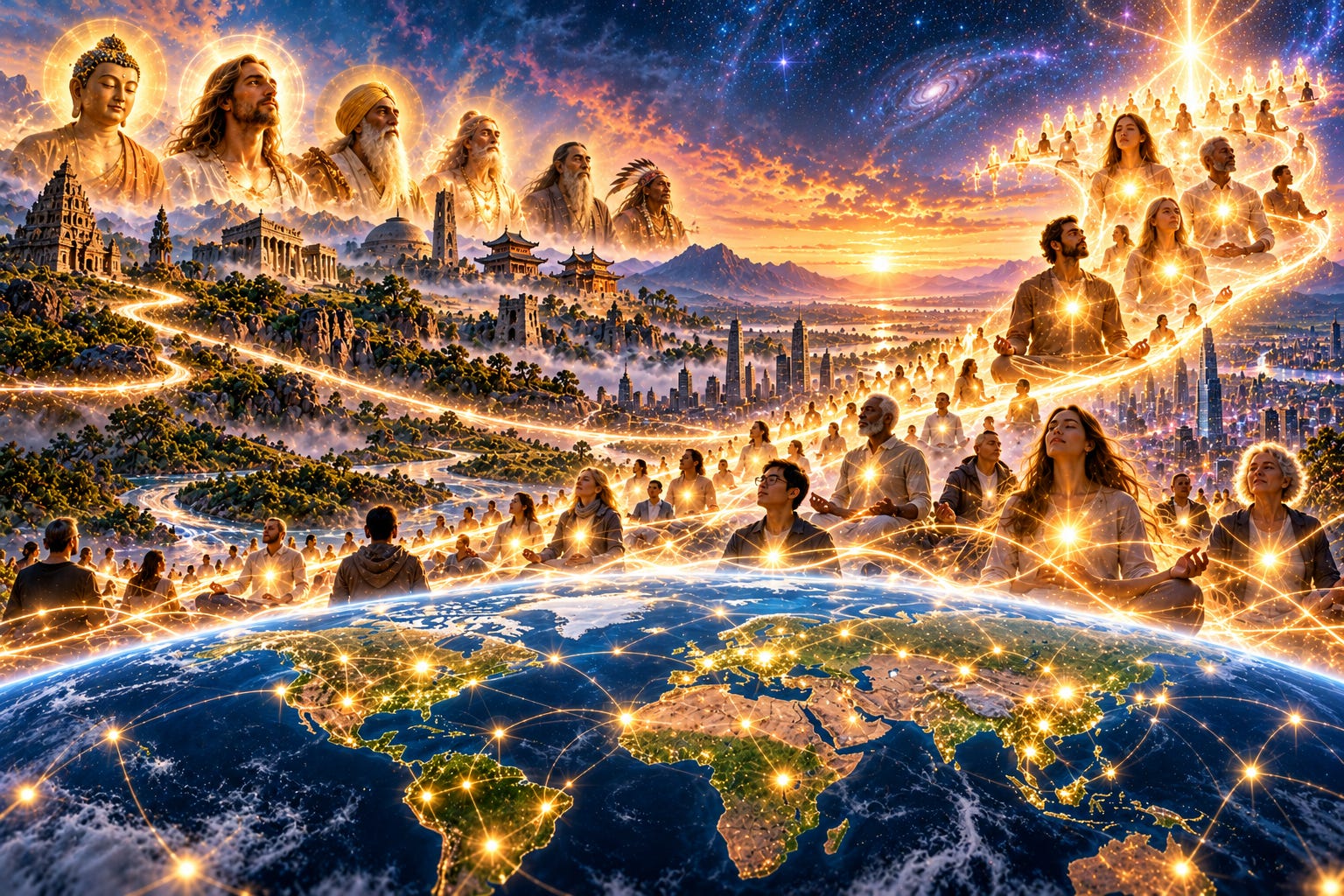
Today’s spontaneous awakenings are partly cumulative: every initiation and awakening leaves an imprint upon humanity, gradually making subsequent awakening easier. Its metaphor is excellent—the ground has been cultivated for centuries, so seeds that once required a gardener can increasingly germinate by themselves.
There has been a movement away from spiritual transmission concentrated in one individual toward transmission through many awakened people, with less dependence upon personality or hierarchy.
For much of human history, perhaps consciousness needed rare concentrated openings.
A Buddha.
A Jesus.
A Nanak.
A succession of mystics and Masters.
These were rather like wells drilled through an otherwise difficult geological layer. People gathered around the opening because water was scarce.
But suppose thousands of years of spiritual activity gradually changed the collective field—not magically in a simplistic sense, but cumulatively. Millions meditating, praying, contemplating, surrendering, suffering, loving, awakening and transmitting something onward.
Then there could eventually come a threshold at which what once required an extraordinary individual becomes increasingly accessible to ordinary individuals.
That would produce exactly the transition we appear to be discussing:
Age of Masters → Age of Religions → Age of Seekers → Age of Distributed Awakening.
There are also perfectly ordinary mechanisms contributing to the recent acceleration. Literacy expanded enormously. Travel brought traditions together. Psychology gave people new language for inner experience. Radio, television and especially the internet dissolved geographical monopolies on spiritual knowledge. Meditation moved from monasteries into ordinary homes. Someone having an unusual experience today can discover within minutes that thousands of others report something similar.
So some of the acceleration is unquestionably communication and visibility.
But I don’t think that necessarily explains all of it.
The deeper question is whether the underlying incidence of awakening is itself increasing.
And here we reach something that cannot presently be established objectively, but which I think deserves to remain open.
If consciousness is fundamental rather than merely generated by brains, then humanity could possess something analogous to a collective threshold. Individual awakenings might not be independent events. Each realization could slightly alter the probability landscape for those who follow.
Then spiritual evolution would be nonlinear.
For thousands of years almost nothing seems to happen.
Then something begins to happen.
Then increasingly many people awaken.
Then the curve steepens.
And eventually a phenomenon once associated almost exclusively with saints and Masters begins appearing spontaneously among people who have never belonged to a spiritual tradition.
Perhaps the disappearance of the Master-centred transmission was not simply spiritual failure.
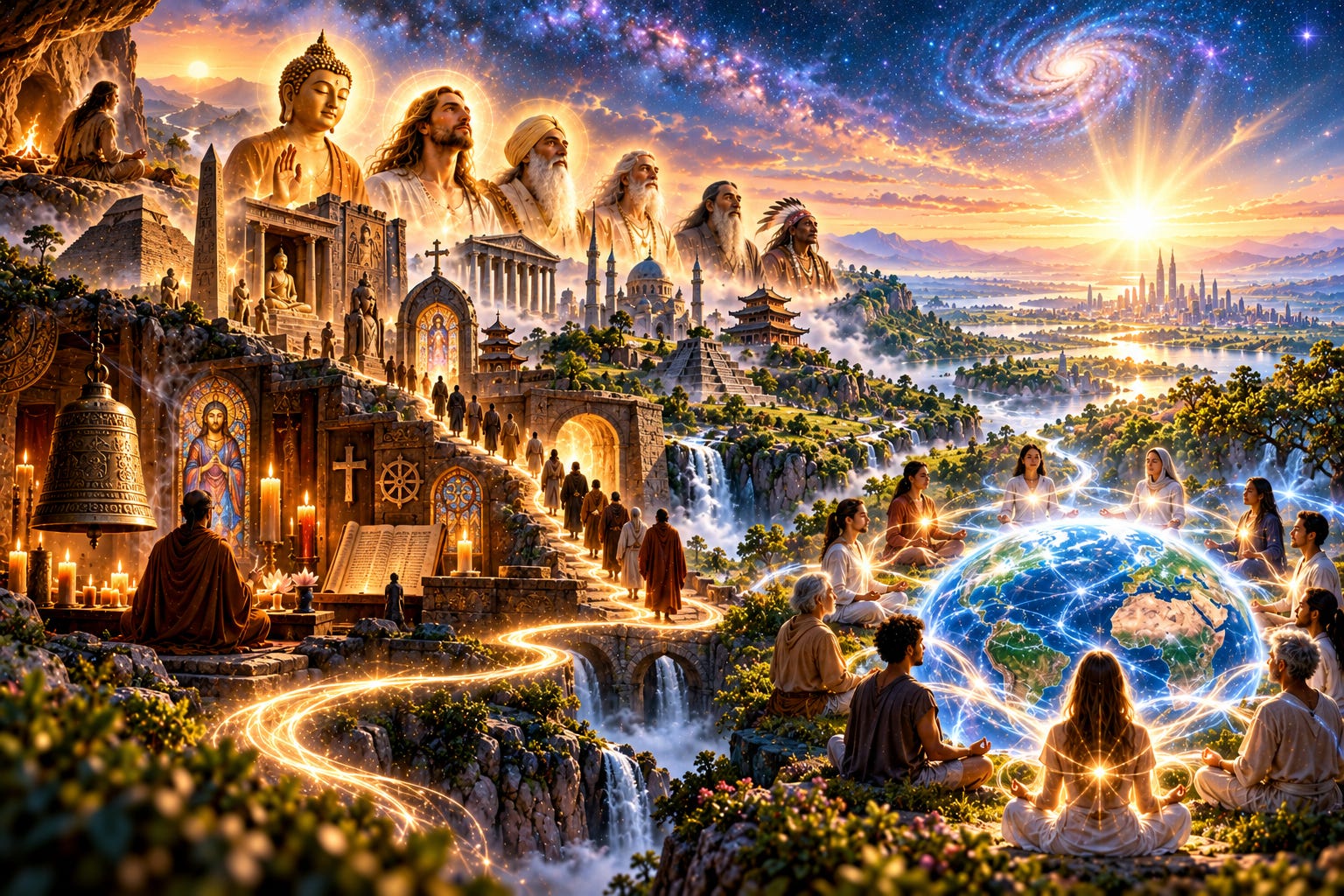
It may have been part of a very long developmental process.
Humanity first needed revelation embodied in exceptional individuals.
Then it needed religions to preserve fragments of those revelations across centuries.
Then it needed enough collective maturity to begin looking beyond the institutions back toward direct experience.
And now we may be entering a period in which the ancient movement reverses:
symbol → experience belief → knowing religion → spirituality external authority → inner realization one Master → many conduits
If that is even approximately true, the present acceleration isn’t merely another spiritual revival.
It would represent a change in the architecture by which spiritual realization enters humanity.
And that makes the apparent historical loss of Light & Sound after individual Masters much more intelligible. The current may never have disappeared at all. What disappeared repeatedly were the human structures capable of consciously transmitting it.
Perhaps what is changing now is precisely that.
There is something quietly beautiful in contemplating this: bells may have continued ringing for centuries after people forgot what they were pointing toward—and now, perhaps, some are beginning to hear the Sound again.
This article has been reproduced in the following video