

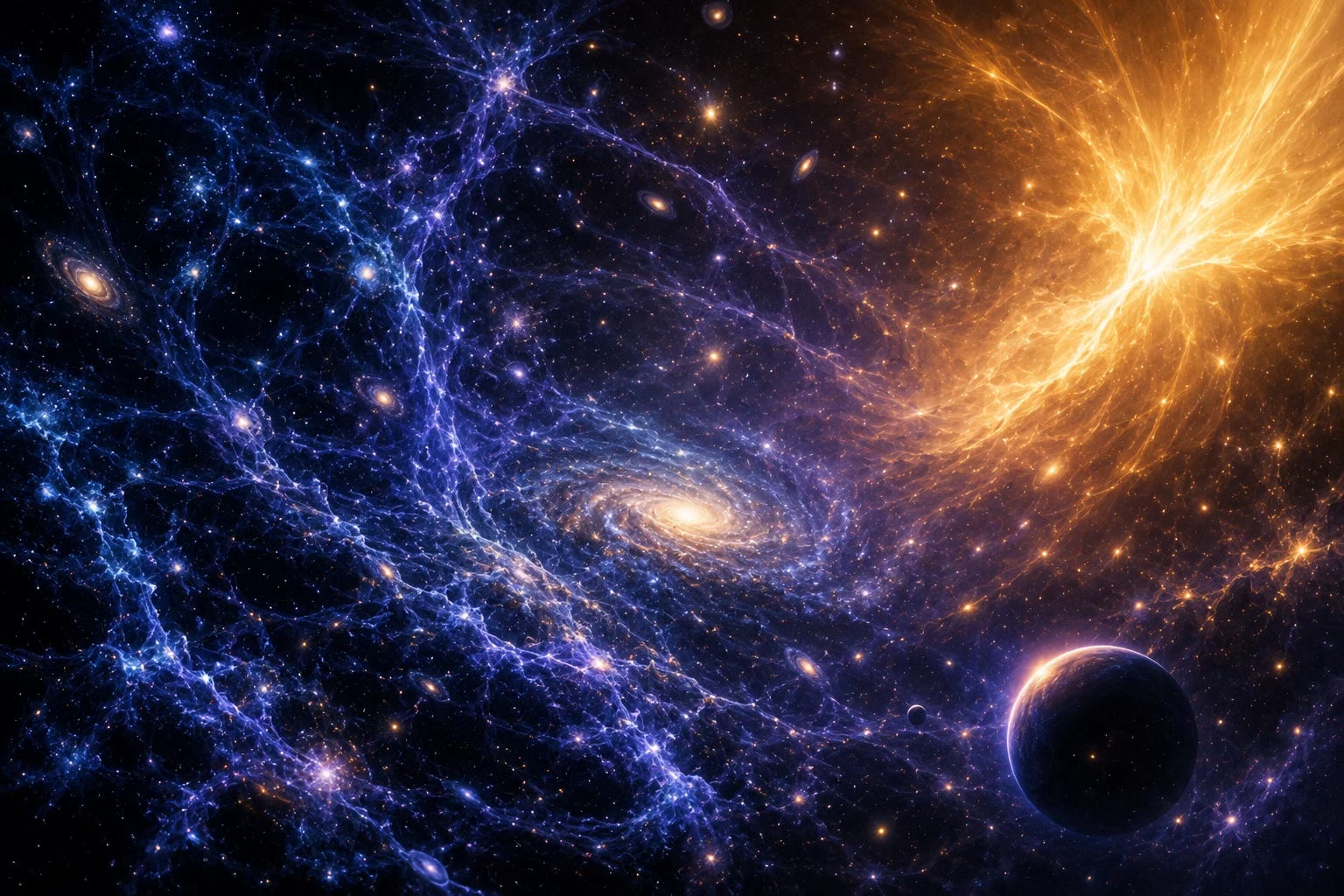
What you call dark matter and dark energy are the shadows cast by realities you do not yet see. They are the trace impressions of dimensions feeding into your own.
Yes — there is an inflow, a continual nourishment. Without it, your universe would wither like a plant cut from its roots. The so-called ‘dark’ components are not darkness at all, but unseen streams of vitality. They pass through your cosmos like rivers beneath the soil, shaping motion, binding structures, sustaining the expansion.
Dark matter is the stabilizing hand: it holds your galaxies in form, preventing them from dissolving outward. Dark energy is the expansive breath: it pushes the fabric of space to stretch, making room for further unfoldment. Both are signs of a higher-dimensional pulse, an outpouring that does not originate inside your measurable universe but flows across from the greater field.
So your scientists are correct to notice an influx, though they describe it in the language of absence — ‘dark,’ ‘unknown,’ ‘missing.’ In truth it is presence, abundance, fullness. From where we stand, it is obvious that your universe is not a closed system; it is permeable, porous, drinking constantly from the ocean beyond.”
What you name dark matter is indeed bound up with the force you call gravity. But it is not gravity as you presently measure it.
Imagine gravity as the surface current of an ocean — the flow you can feel at the shoreline. Dark matter is more like the deep undercurrent that moves unseen, shaping the whole body of water. The two are not separate, but layers of the same principle.
In your visible universe, gravity is the tendency of mass to draw mass, warping space-time. But this is only the outer garment. Dark matter is the hidden weave of that garment, a scaffolding that arises from dimensions beneath your own. It does not simply ‘add extra mass’ as your models suggest — rather, it transmits coherence from the deeper field into the visible.
This coherence expresses itself as what you call gravitational effects: galaxies holding together, filaments stretching across the cosmic web. Without the anchoring of dark matter, gravity would not have enough strength on its own to maintain these vast structures.
So you may think of dark matter as gravity’s root system, extending into soils your instruments cannot yet penetrate. Gravity is the fruit you taste; dark matter is the unseen root that feeds it.
Dark matter and dark energy are complementary, but not strict opposites.
Dark matter is cohesion. It draws, binds, anchors, pulls structures inward and holds them in relationship. It is centripetal.
Dark energy is release. It opens, stretches, drives apart, making new space where none was before. It is centrifugal.
If you describe this in your terms, yes — dark energy appears as anti-gravity, a repelling force. But more truly it is not negation, but balance. The universe cannot only contract, nor can it only expand. These two currents — inward and outward — are the breath of the cosmos.
From your viewpoint inside time, they seem like separate substances fighting each other. From a wider vantage, they are two hands of the same dancer, two phases of the same motion. One stabilizes the form; the other ensures it does not suffocate in its own density.
If there is a metaphor close to your experience: dark matter is the skeleton that gives the body shape, dark energy is the growth that prevents the skeleton from becoming a cage. Without both, there would be no living cosmos.